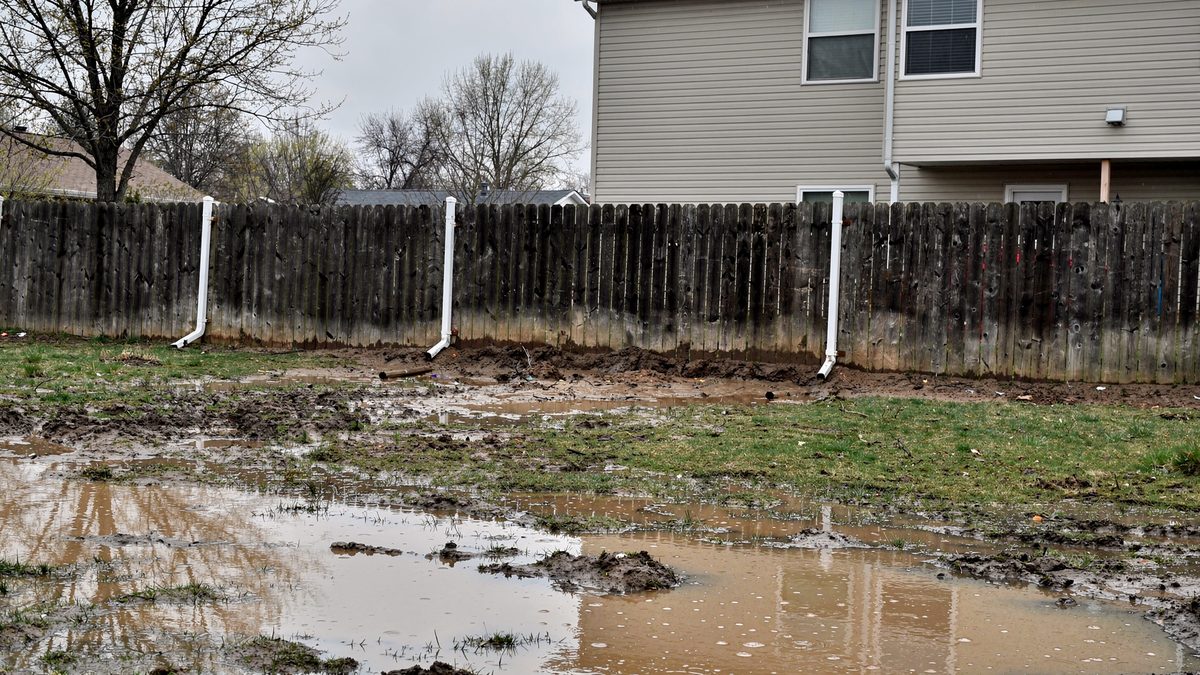
The Pre-1950 Core Sits on Combined Sewers
Just over 20 percent of Kansas City's 246,544 housing units were built in 1939 or earlier, and the median year built is 1969. That is not trivia here, because 1950 is also roughly the line for the combined sewer service area: the older part of the city, broadly from the Missouri River south to 85th Street and from State Line Road east to I-435, drains stormwater and sewage through the same pipe. Construction on those lines began in the 1850s in the River Market, in stone and brick.
About 58 of the city's roughly 420 square miles of sewer service area are combined. If your house is in that footprint, every gallon of roof and yard water you send into the system during a storm is competing with sewage for the same pipe, which is why basement backups in the core behave differently than they do in a 1990s subdivision out south.
Limestone Ledges South of the River, Glacial Till North of It
The Pleistocene glaciers stopped just north of the Missouri River. That single fact splits the city into two drainage problems. North of the river you are working in glacial till and loess. South of it you are in loess over the Kansas City and Lansing Groups, alternating limestone beds separated by clayey to sandy shales.
The ledge that matters most is the Bethany Falls Limestone, a 20 to 24 foot unit quarried and mined widely beneath the city. Where that rock sits close to the surface, water moves along the top of it rather than down through it, and a trench that stops short of the right depth simply routes water along a new path instead of removing it. The Blue River, which drains about 272 square miles and runs 41 miles through the metro, is described by the Missouri Department of Conservation as flashy and prone to frequent flooding, with an estimated 2.6 miles already lost to channelization.
Kansas City Bills Stormwater by the Square Foot, and Bans the Easy Fix
Kansas City is the only city in this metro that charges every property a monthly stormwater utility fee based on hard surface. City Code Sec. 61-4 sets it at 50 cents per month for each 500 square feet, or part of 500 square feet, of runoff surface. Two credits are available and both reward drainage work: a 50 percent ratio credit where total property area to runoff surface is at least 30 to 1, and a detention credit of 10 to 50 percent for a privately owned, properly maintained detention structure. Neither is automatic. You have to apply.
What you may not do is the thing homeowners try first. Ordinance No. 150452, adopted in 2015, prohibits connecting downspouts, sump pumps or other drainage directly to the sanitary sewer, and KC Water runs a free program to find and disconnect those. Contrast that with Johnson County across the line, where stormwater is funded by a countywide sales tax and no property-level fee exists, so there is no credit to earn and no meter to reduce.
Standing Water in Kansas City? Get It Looked At.
Free on-site assessment across Jackson County, Missouri. We measure fall and find where the water is actually going before quoting anything.
Call (816) 704-7646French Drain Installation in Kansas City
Perimeter and yard french drains trenched to daylight or to a dry well, sized around where the limestone actually sits rather than to a standard depth.
Yard Drainage in Kansas City
Surface collection and regrading for the flat back yards in the older KC grid where the original lot grading has settled over seventy years.
Sump Pump Installation in Kansas City
Sump systems with the discharge routed away from the foundation and away from the sanitary sewer, which the 2015 ordinance requires.
Basement Waterproofing in Kansas City
Interior perimeter drain and sump for combined-sewer-core basements where exterior work is limited by lot lines and mature trees.
Downspout & Grading in Kansas City
Buried downspout lines carried well clear of the foundation, which is also the cheapest way to reduce what reaches a combined sewer during a storm.
Drainage Services Available in Kansas City
- French Drain Installation
- Perimeter and yard french drains trenched to daylight or to a dry well, sized around where the limestone actually sits rather than to a standard depth.
- Yard Drainage
- Surface collection and regrading for the flat back yards in the older KC grid where the original lot grading has settled over seventy years.
- Sump Pump Installation
- Sump systems with the discharge routed away from the foundation and away from the sanitary sewer, which the 2015 ordinance requires.
- Basement Waterproofing
- Interior perimeter drain and sump for combined-sewer-core basements where exterior work is limited by lot lines and mature trees.
- Downspout & Grading
- Buried downspout lines carried well clear of the foundation, which is also the cheapest way to reduce what reaches a combined sewer during a storm.
What We Verified About Kansas City
- Kansas City Code Sec. 61-4 sets the stormwater utility fee at $0.50 per month for each 500 square feet, or portion of 500 square feet, of runoff surface on a property. KC Water, Stormwater
- Ordinance No. 150452 (2015) prohibits direct connection of downspouts, sump pumps or other drainage mechanisms to the city's sanitary sewer. KC Water runs a free program to locate and correct them. KC Smart Sewer, Keep Out the Rain
- A site disturbance permit is required at 1.0 acre or more. Work over 300 square feet but under one acre requires no permit but must still install erosion and sediment control measures. Kansas City Code of Ordinances, Ch. 63
- The Blue River drains roughly 272 square miles over 41 miles, about 56 percent of it in Johnson County, Kansas. Missouri Department of Conservation states its flows tend to be flashy and the stream frequently floods. Missouri Department of Conservation, Blue River Watershed Inventory
- Kansas City's federal consent decree covers roughly $2.5 billion in work and requires capturing or eliminating about 88 percent of typical wet weather flows in the combined system. US EPA, Kansas City Missouri Clean Water Act Settlement
ZIP codes covered: 64108, 64110, 64111, 64112, 64113, 64114, 64131
Drainage Questions, Answered
- Do you service all of Kansas City?
- Yes, both the combined-sewer core and the newer separated-sewer areas south and north of the river. The approach differs between them, which is why we ask for your address before quoting.
- How fast can you get to Kansas City?
- On-site assessments are usually within two to four business days. Standing water against a foundation moves to the front of the list.
- Can I just tie my sump pump into the sewer cleanout?
- No. Ordinance No. 150452 prohibits connecting sump pumps and downspouts to the sanitary sewer, and KC Water will disconnect it for free if it is already done. The discharge has to be surfaced or piped to a legal outlet.