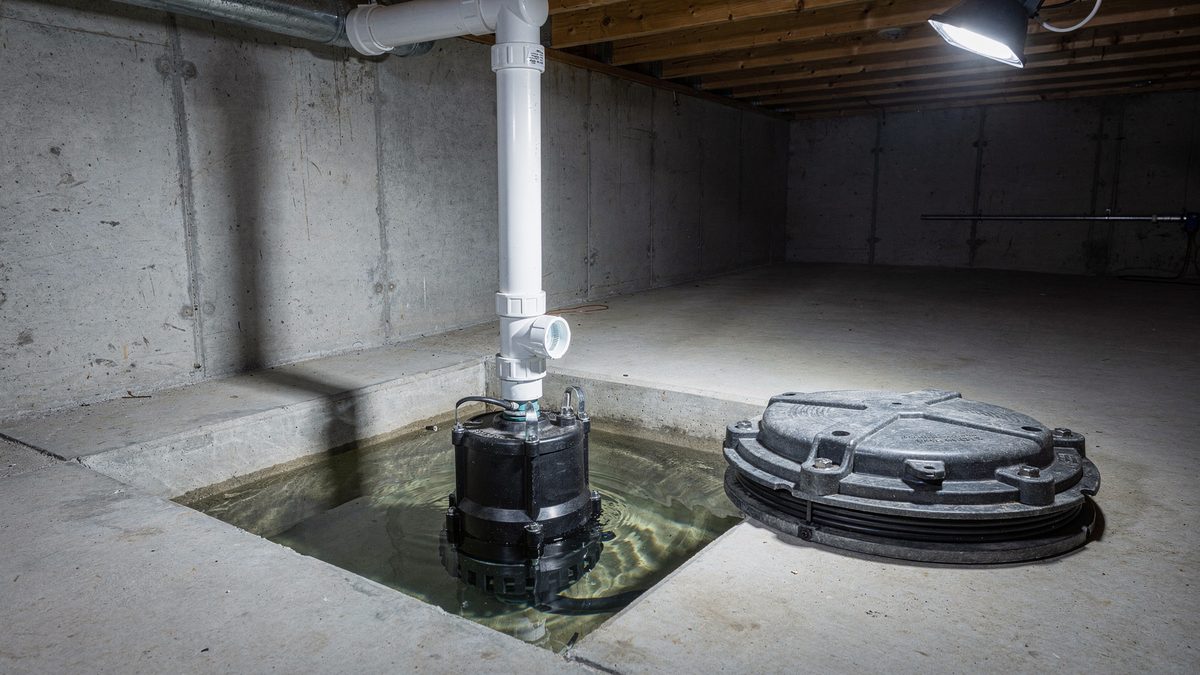
When a Sump Is the Right Answer
A sump pump is the answer when water has to be collected below the level it can leave by gravity. That is a basement floor below the outlet, or a low back yard on a lot with no fall anywhere. If gravity is available, use gravity.
It never fails, never needs power and never needs replacing.
Most Kansas City basements that need one need it because the interior perimeter drain, or the exterior footing drain if there is one, has to discharge somewhere and the ground outside is higher. On the older housing stock in Independence and the Kansas City core, there is often no functioning footing drain at all, and the sump becomes the entire drainage system.
Basin, Pump, Check Valve, Backup
A proper installation is a sealed basin set in washed rock, a pump sized to the actual inflow rather than to the biggest number on the shelf, a check valve so the discharged column does not fall back and short-cycle the pump, and a discharge line that maintains fall and does not freeze at the outlet.
Battery backup matters more here than people expect, because the storms that produce the most inflow are the same storms that take the power out. A primary pump with no backup works except on the days you need it. We price backup as an option and tell you plainly what it covers, which is hours of runtime, not days.
Pricing
A new sump system typically runs quoted from a written scope installed, covering the basin, the pump, the check valve and the discharge line. Cutting a basin into an existing concrete floor, long discharge runs, and battery backup are what move a job up that range. A straight pump swap in an existing serviceable basin is much less.
You get the pump model, the horsepower, the basin spec and the discharge route in writing before we start. Sizing should be based on what your system actually produces during a storm, not on a guess.
Where the Discharge Can Legally Go
This is the part that varies most by city and the part most likely to be done wrong. In Kansas City, Ordinance No. 150452 prohibits connecting sump pumps or downspouts to the sanitary sewer, and KC Water runs a free program to find and disconnect existing ones. That is not a technicality: in the combined sewer core, sump water sent into the sewer is competing with sewage during exactly the storm when the system is fullest.
In Overland Park, OPMC 7.54.250 requires that intermittent discharges such as sump pumps not be discharged closer than five feet to any adjoining property line, and constant discharge reaching a sidewalk or street can be abated as a public nuisance. On a narrow lot that setback drives the whole discharge design, and a contractor working mostly on the Missouri side will get it wrong.
Schedule Sump Pump Installation in the Kansas City Metro
Free on-site assessment.
Call (816) 704-7646Sump Pump Installation Available In
- Kansas City, MO Jackson County, Missouri
- Overland Park, KS Johnson County, Kansas
- Olathe, KS Johnson County, Kansas
- Lee's Summit, MO Jackson County, Missouri
- Independence, MO Jackson County, Missouri
Drainage Questions, Answered
- How long does a sump pump last?
- Seven to ten years is typical for a primary pump in normal service. A pump that short-cycles because of a missing or failed check valve will die much sooner than that.
- Can my sump discharge into the sewer cleanout?
- Not in Kansas City. Ordinance 150452 prohibits it, and KC Water will disconnect an existing connection at no charge. Other cities in the metro treat it similarly, and it is bad practice everywhere.
- Do I need a battery backup?
- If losing the pump means water in a finished basement, yes. The storms that produce the highest inflow are the ones most likely to cut power, so a primary-only system is unprotected exactly when it matters.